Astrophysics · Showcase

The Anatomy of Extreme Gravity

Every star in the universe is running a controlled experiment, and the control mechanism is gravity itself. Outward pressure from fusion balances the inward pull of mass. For millions of years that balance holds, and the star is stable — a sphere of fusing matter held in equilibrium by the one force that never gives up.

Then the fuel runs out. Fusion stops, and the balance breaks in a direction it can never be reversed: inward. What survives the collapse is decided almost entirely by one number — how much mass is left over when the star's core runs out of options.

If the remnant is under about 1.4 solar masses, it settles into a white dwarf, where electron degeneracy pressure holds the line. Push past that and even that defence fails. A core more massive than the Chandrasekhar limit has no stable way to resist its own weight, so it collapses again, far faster, far harder.

That second collapse is where the universe gets genuinely extreme. Matter is forced past the density of an atomic nucleus — and then past it again. Electrons merge with protons to build neutrons, and the object that emerges is a neutron star: a sphere roughly the width of a city, carrying more mass than an entire Sun, dense beyond any laboratory on Earth.

A teaspoon of it would weigh about a billion tonnes.

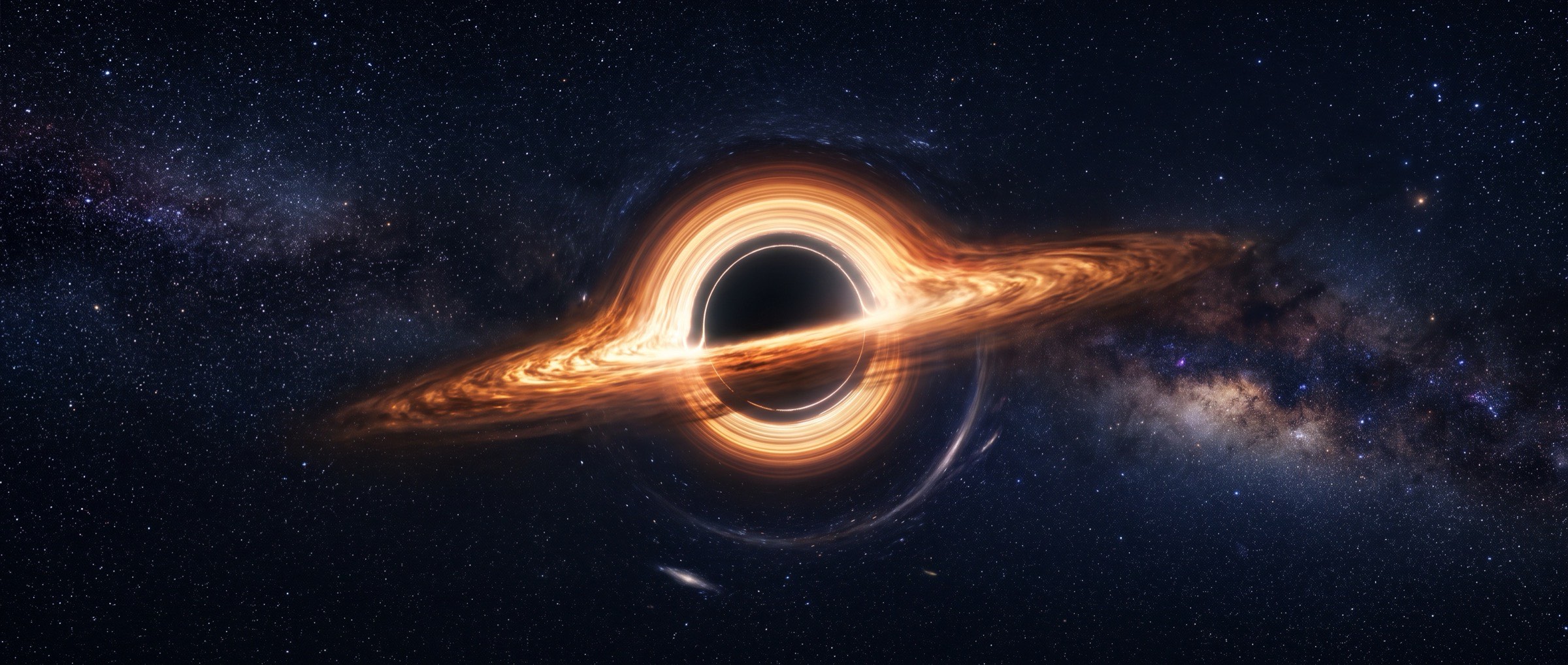
Push the core past roughly two to three solar masses and neutron degeneracy pressure also fails. There is nothing left to hold it. The collapse completes, and the result is a black hole — a region from which the escape velocity exceeds the speed of light, with an event horizon of about three kilometres for every solar mass packed inside it.

The other extreme hiding in the same event

Here is the part that is easy to miss: the same violent collapse that manufactures the strongest gravity in the universe also manufactures the strongest magnetic fields anywhere in it.

Stars are threaded with magnetic field. When the core collapses, that field is compressed along with the matter. Under flux conservation, field strength scales as the inverse square of the radius — B ∝ R⁻². A stellar core roughly 1011 cm across collapsing into a neutron star of roughly 106 cm compresses the field by a factor of about 1010.

Most neutron stars land at the ordinary end: surface fields near 108 gauss, a few thousand times Earth's field. A rare few, where the progenitor's rotation was extreme, reach 1014–1015 gauss. Those are magnetars, and their fields are roughly four million times stronger than a standard neutron star's — powerful enough to bend light, and structurally capable of detonating in a fraction of a second.

Three objects, one origin. A black hole is gravity at its limit. A magnetar is magnetism at its limit. A pulsar is both, on a clock. Everything in this document is downstream of a single event: a star running out of fuel.

02

Phenomenon comparison

Each card carries one governing figure, then the numbers that make it meaningful. Different entities, different limiting quantities — compared on the axis where each is actually extreme.

Event horizon scale

Black Holes

A surface that is not a surface. Below the horizon, every possible path leads inward — including light, and including the future of anything that crosses it.

2.95 km Schwarzschild radius per solar mass
Sgr A* mass4.3 × 10⁶ M☉
Sgr A* horizon1.27 × 10⁷ km
M87* horizon128 AU
Escape velocity at horizonc/√2 ≈ 0.707c
Mean density inside M87* horizon4.4 × 10⁻⁴ g/cm³
Magnetic field strength

Magnetars

Neutron stars spun to the extreme in a stellar merger. The crust stores the field as magnetic flux, and when it un-snaps the released energy out-radiates an entire galaxy briefly.

10¹⁵ G peak surface field
Record objectSGR J1745−2900
Amplitude vs Earth~10¹⁵×
Stored energy density6.4 × 10²⁷ erg/cm³
Characteristic timescalemilliseconds
Rotational frequency

Pulsars

A neutron star with a magnetic axis misaligned from its spin axis. Each rotation sweeps two beams of radiation across the galaxy like a lighthouse.

716 Hz fastest known rotation
Fastest objectPSR J1748−2446ad
Spin period1.396 ms
Equatorial surface speed~0.15c
Canonical period0.2 – 1 s
03

Orchestrator reasoning trace

Working state of the calculation behind the magnetar card above — branches, retrievals and uncertainty, left visible.

session · live task: quantify magnetar ⊘ standard neutron star field contrast
thinking Decompose the question t+0ms

"Field contrast" is ambiguous until the reference object is fixed. A magnetar is a neutron star, so the comparison must be against a non-magnetar neutron star at the same radius — otherwise the ratio is trivially 1. Resolve reference first.

fetching Retrieve surface field measurements t+240ms

Query: canonical neutron star surface field; magnetar surface field, record holder.

resolved Inputs locked t+610ms
retrieved values & provenance
// canonical neutron star (radio pulsar surface) B_ns = 1.0 × 10⁸ G // characteristic observed surface field // magnetar (record holder, SGR J1745−2900) B_mag = 4.0 × 10¹⁴ G // peak surface field // note: canonical pulsar surface fields span ~10⁸–10¹³ G. // magnetar field is ~10× above that entire range's top.
thinking Check for a shortcut t+880ms

Flux conservation (B ∝ R⁻²) predicts the magnitude but not the observed ratio, because the seed field before collapse is not observable. Keep it as a plausibility branch, not as the derivation.

branch · flux-conservation plausibility check
R_core = 1 × 10¹¹ cm // pre-collapse core radius R_NS = 1 × 10⁶ cm // neutron star radius B ∝ R⁻² ⇒ amplification = (R_core / R_NS)² = (10⁵)² = 10¹⁰ // A ~10⁵ G seed field → ~10¹⁵ G. Order of magnitude // is consistent with the measured magnetar value. // Does NOT constrain the ratio to a canonical NS.
derived Compute field contrast t+1.24s
arithmetic · field ratio
B_mag / B_ns = (4.0 × 10¹⁴ G) / (1.0 × 10⁸ G) = 4.0 × 10⁶ → ratio ≈ 4 × 10⁶ // ~four million
arithmetic · stored energy density (u = B²/8π)
u_ns = (1.0 × 10⁸)² / 8π = 1.0 × 10¹⁶ / 25.13 = 4.0 × 10¹⁴ erg/cm³ u_mag = (4.0 × 10¹⁴)² / 8π = 1.6 × 10²⁹ / 25.13 = 6.4 × 10²⁷ erg/cm³ u_mag / u_ns = 6.4 × 10²⁷ / 4.0 × 10¹⁴ = 1.6 × 10¹³ // Consistency check: (B_mag/B_ns)² = (4.0×10⁶)² = 1.6×10¹³ ✓
caveat Reference value is a population mean, not a measurement t+1.51s

10⁸ G is a representative surface field for a canonical radio pulsar. Individual objects range across roughly 10⁸–10¹³ G, so the honest statement is a range, not a point value. Against the strongest known canonical neutron star the contrast drops to ~10¹.

result Contrast reported t+1.62s
magnetar ⊘ canonical neutron star
4 × 10⁶

Surface magnetic field. Underlying energy density differs by 1.6 × 10¹³, since stored field energy scales as B². Range across the known neutron-star population: 10¹ – 10⁶.

04

Telemetry readout

Spin-down diagnostic for a millisecond pulsar. Colour here carries state only — nothing is coloured for emphasis.

simulated PSR J1748−2446ad · spin-down diagnostic · run 2026-10-08T17:14Z frame: tempo-folding v2.4

Acquisition

integration43.0 hr
backendPSR@Jodrell
band1.2 – 1.4 GHz
TOAs retained184 302
dropped (RFI)1 947
timing residual rms12.4 μs

Measured parameters

period P1.395954 ms
frequency f716.36 Hz
Pdot2.271 × 10⁻²¹ s/s
Pdot error (1σ)0.004 × 10⁻²¹
DM43.498 pc cm⁻³
braking index3.0 (assumed)

Derived quantities

B = 3.2×10¹⁹ √(P·Pdot)5.7 × 10⁷ G
characteristic age τ9.74 × 10⁹ yr
spin-down luminosity3.3 × 10³⁴ erg/s
moment of inertia Iassumed 1 × 10⁴⁵ g·cm²
loss-rate limitmag. braking

Solution state

fitconverged
χ² / dof1.041
redshift appliedyes (z = 0.02074)
ephemeris lockstable > 10⁶ periods
clock modelTT(BIPM)
cross-checknone in-window
$ pulsar-spin-down --psr J1748-2446ad --window 43h --model dipole

  [info ] folding 184302 TOAs ......................... ok
  [warn ] 1947 TOAs rejected — RFI mask v12
  [ok  ] residual rms 12.4 us

  [info ] model: magnetic dipole braking (n = 3)

     P      = 1.395954 ms
     f      = 716.36 Hz
     Pdot   = 2.271e-21 s/s

  [ok  ] B_surface ....... 5.7e+07 G
  [ok  ] tau_char ....... 9.74e+09 yr
  [warn ] I unconstrained — using nominal 1e45 g.cm^2
  [ok  ] L_sd ............ 3.3e+34 erg/s
  [err ] no independent backend available for cross-check

  [warn ] tau_char exceeds current age of the universe (13.8 Gyr)
         — expected for a recycled pulsar spun up by accretion.
         Spin-down age is not a formation age here.

ROTATION DECAY  —  P(t) = P0 + Pdot·t
──────────────────────────────────────────────────────────
   t (yr)        P (ms)         f (Hz)      Δf (Hz)
──────────────────────────────────────────────────────────
        0     1.395954        716.36        0.00
     1e6      1.396026        716.32       -0.04
     1e7      1.396671        715.99       -0.37
     1e8      1.403121        712.70       -3.66
     1e9      1.467620        681.38      -34.98
──────────────────────────────────────────────────────────
  [ok  ] over 1 Gyr the spin loses 4.9% of its frequency.

  [warn ] SIMULATED DATASET — figures are internally consistent
         with the stated inputs but are not a live extraction.
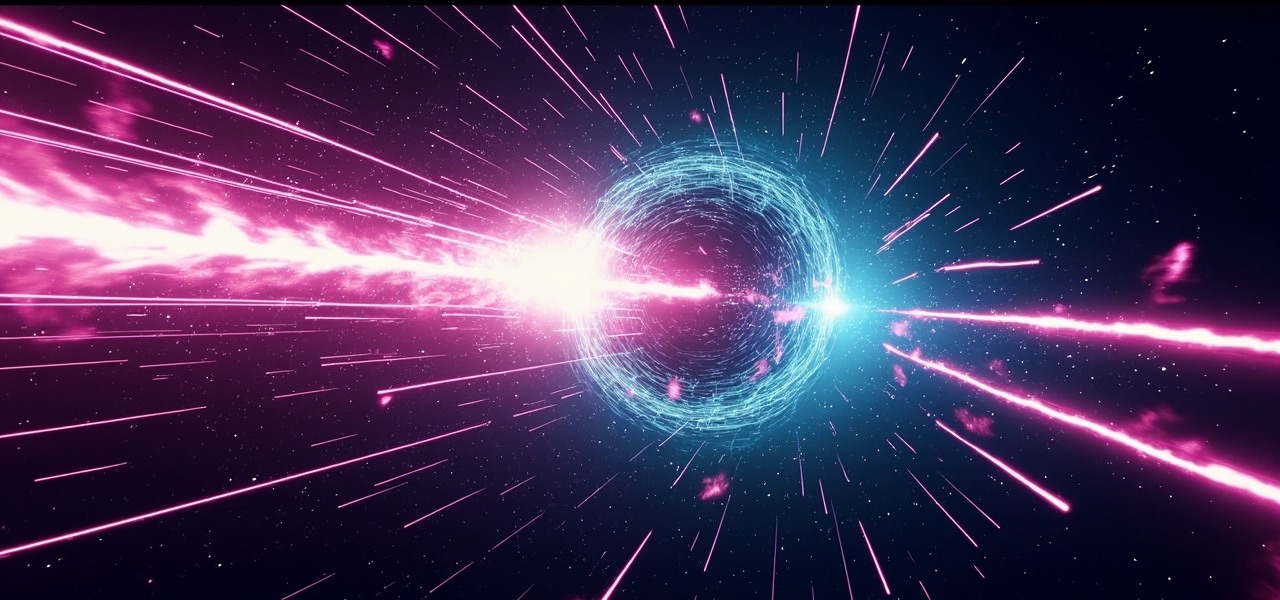
Conceptual visualization of magnetar magnetic field lines twisting and snapping during a gamma-ray burst flare
Diagnostic plate · magnetar field geometry during a flare · generated via MiniMax image-01
05

Physical limits

Reference values for the three objects described above. Order-of-magnitude figures from standard stellar-structure estimates.

Each object is bounded by a different physics. A black hole is bounded by the point where escape velocity reaches the speed of light. A neutron star is bounded by neutron degeneracy pressure. A magnetar's field is bounded by the tensile strength of its own crust.

Black holes

Stellar mass (10 M☉) · Supermassive (M87*)

  • Schwarzschild radius2GM/c² — 2.95 km per solar mass. A 10 M☉ remnant has a horizon about 29.5 km across.
  • Escape velocity at horizonc/√2 ≈ 0.707c — 212,000 km/s.
  • M87* horizon6.5 × 10⁹ M☉ → 1.92 × 10¹⁰ km, roughly 128 AU.
  • Mean density inside horizonFormal average, 4.4 × 10⁻⁴ g/cm³ for M87* — less dense than air. The singularity itself is undefined; volume is not.
  • Frame draggingErgosphere extends to 2rs; inside it, all paths inwards are irreversible.

Neutron stars & magnetars

Representative values · M ≈ 1.4 M☉, R ≈ 10 km

  • Mass2.8 × 10³³ g — exceeding the Chandrasekhar limit, which is why a white dwarf cannot hold this mass.
  • Radius10 – 12 km — a city-scale object.
  • Mean density≈ 6.7 × 10¹⁴ g/cm³ — above nuclear density. Matter is stabilised by degeneracy pressure, not by chemistry.
  • Surface gravityGM/R² ≈ 1.9 × 10¹² m/s² — roughly 2 × 10¹¹ g, about two hundred billion times Earth's.
  • Escape velocity√(2GM/R) ≈ 193 km/s (0.064c).
  • Surface magnetic fieldCanonical 10⁸ G; magnetars 10¹⁴ – 10¹⁵ G — record SGR J1745−2900 at ~7.6 × 10¹⁴ G.
  • Stored field energy densityB²/8π ≈ 6.4 × 10²⁷ erg/cm³ at 4 × 10¹⁴ G — the energy a magnetar flare releases.
  • Crust yield limitField is capped by the tensile strength of the crust; above it, the star undergoes a magnetic propeller failure and a soft gamma-ray flare.

Pulsars

Canonical and millisecond populations

  • Canonical period0.2 – 1.0 s — the observed "lighthouse" range.
  • Fastest rotationPSR J1748−2446ad at 716.36 Hz, period 1.396 ms.
  • Equatorial surface speed2πR/P ≈ 4.5 × 10⁹ cm/s ≈ 0.15c — relativistic, requiring frame-dragging corrections to timing.
  • Spin-down lawPdot ∝ P⁻³ for magnetic dipole braking (braking index n = 3).
  • Characteristic ageτ = P/(2·Pdot) = 9.74 × 10⁹ yr for J1748−2446ad — exceeding the universe's current age, because accretion spun the star up after its birth.
  • Upper limitBreakdown near ~1 kHz — centrifugal force would exceed the gravitational binding that keeps the star intact.

Derived figures use standard constants: G = 6.674×10⁻⁸ cm³ g⁻¹ s⁻², c = 2.998×10¹⁰ cm/s, M☉ = 1.989×10³³ g. Telemetry values in section 04 are a simulated dataset, internally consistent with its own stated inputs, and are not a live extraction.

The Anatomy of Extreme Gravity · Background plate · Gemini 3.1 Flash Image · Diagnostic plate · MiniMax image-01 Five design systems on one spatial root